
Equipment
- Directional drilling and MWD/LWD tools
- Rotary steering and stabilizer systems
- Completion and flow-control tools
- High-pressure fluid and sand-control equipment

DRILLING, COMPLETION & FLOW-CONTROL WEAR COMPONENTS
Engineer carbide components around pressure, erosive solids, corrosion, temperature, magnetic requirements and the mating assembly.
APPLICATION FIT
WORKING CONDITIONS
A useful recommendation starts with the load, environment and mating system. Include measured data when available and describe field conditions when it is not.
COMMON FAILURE MODES
COMPLETE TOOL + CARBIDE
Capability note: complete assemblies are evaluated against the drawing, sample, production volume and available technical evidence. No field-life claim is made until a controlled trial is completed.
VERIFIED COMMERCIAL EVIDENCE
The evidence below comes from Ruixin's current product catalogue and public certification page. It demonstrates published material and custom-geometry capability; it is not presented as a downhole assembly photograph or a customer performance case.
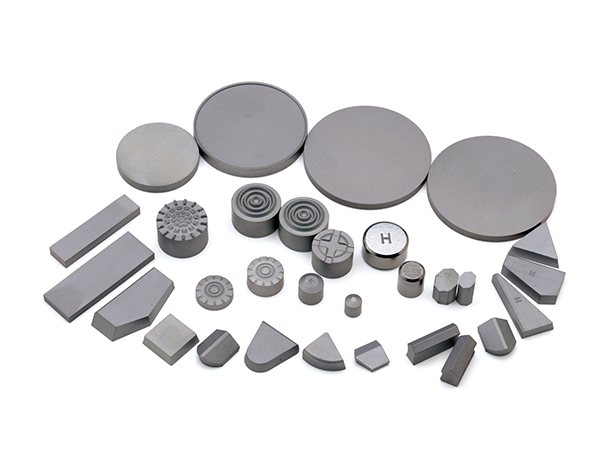
Ruixin studio product photograph of carbide preforms and custom shapes. Representative manufacturing evidence only; not a customer installation.
Open source product →WC-Co is the standard system; WC-Ni, WC-NiCr, WC-Co-Cr and selected TiC- or TaC-added systems are published as custom options.
View material range →Standard cobalt content 6–20%, grain size 0.4–8.5 μm and hardness HRA 85.5–93.5. Final chemistry is confirmed against pressure, fluid and corrosion requirements.
View published specification →Published R&D batches start at 1–5 kg. A first-time formulation is listed at 3–6 weeks; repeat production of an established grade is listed at 2–3 weeks.
View order terms →HRA, density, grain structure and optional XRD are listed as project-level qualification outputs. Management-system certificates are publicly displayed on the company page.
View public certificates →Evidence still required: an approved downhole product or assembly photograph, a redacted material/dimensional report, and one traceable anonymous field case. No standard tolerance is claimed for downhole parts until the drawing and inspection method are approved.
Submit approved evidence or project detailsRECOMMENDED PRODUCT FAMILIES
These families are starting points. Final grade, size, tolerance and assembly scope are confirmed from working conditions.
CUSTOM DEVELOPMENT
Drawing or sample review
Working-condition and failure analysis
Grade, geometry and joining proposal
Sample manufacture and inspection
Field test, feedback and batch release
Carbide system, grain size and binder are selected against the application requirement.
Critical dimensions, interfaces and inspection scope are confirmed before sampling.
Trial quantities and field feedback establish evidence before scale-up.
Inspection and material documents are agreed according to project scope.
CORE TECHNICAL GUIDES
TECHNICAL LIBRARY
Use these supporting articles for selection, failure diagnosis, operating review and purchasing preparation.
FAQ
Nickel-binder or other corrosion-resistant systems may be evaluated when the fluid chemistry can attack cobalt binders. Pressure, temperature, media and required mechanical properties must be reviewed together.
Drawing-based evaluation is available for custom components. Critical dimensions, tolerances, surface finish, material requirement, inspection scope and annual quantity are reviewed before feasibility is confirmed.
Magnetic requirements can be discussed for suitable carbide systems. The required magnetic limits and verification method must be defined in the specification.
ENGINEERING SUPPORT
Share the equipment, material, current part and wear pattern so the recommendation starts with the real working condition.
ENGINEERING INQUIRY
Leave your contact details and a short requirement. Engineering will follow up for drawings and working conditions when needed.


 English
  Russian
  Spanish
  French