
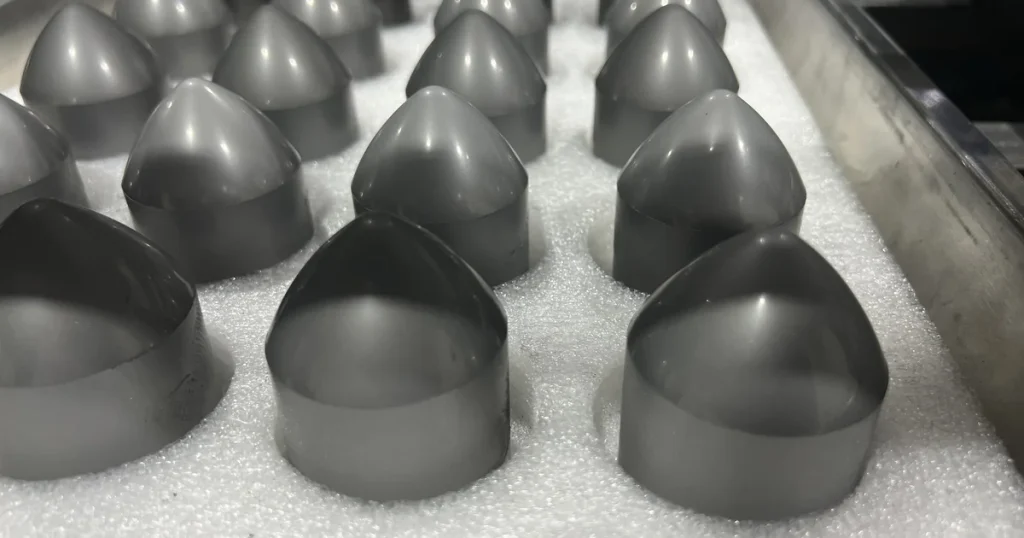
Your EPB shield has just hit a boulder pocket in a metro drive that the geological model told you would be soft clay. Within two rings, three cutter tips have spalled and one insert has fractured away from the steel body. The carbide grade that held up perfectly in abrasive fine sand is now the root cause of an unplanned cutterhead inspection — and the single‑grade procurement decision you made months ago is now the cost driver. Mixed ground does not permit one carbide grade to work everywhere, because the failure mode can switch from pure abrasion to high‑impact fracture inside a single ring.

Quick Answer
For shield machine cutter picks in metro tunneling mixed ground — where clay, sand, gravel, cobble, and boulders alternate — the correct carbide grade follows the dominant failure mode, not a universal specification. In low‑impact, abrasive stretches a finer‑grain, higher‑hardness grade such as Ruixin SR7X (HRA 91.0 ± 0.5, grain size 1.0–1.2 µm) controls wear‑flat progression and keeps the cutting edge sharp longer. When boulders, fractured rock, or cobble‑rich zones deliver repeated impact loads, higher toughness becomes the primary requirement, and Ruixin SR10C (HRA 88.0 ± 0.5, flexural strength ≥ 2,200 MPa, higher cobalt) resists brittle fracture better than harder grades.
In the most common mixed‑face profile — alternating sand‑gravel lenses with sporadic cobbles — a balanced grade like Ruixin SR8C (HRA 89.0 ± 0.5, medium grain size 2.0–3.0 µm) serves as the starting point for face cutters. The selection rule that follows from field experience is to match the grade to the worst failure mode that dominates each cutter ring’s radial position on the head, and be prepared to split grades across zones rather than ordering one grade for all inserts. After the initial excavation interval, pull three cutters from gauge, transition, and face‑center positions and read the wear flats — if gauge inserts show micro‑chipping, switch that position to SR10C; if center cutters display only smooth abrasion, SR7X on those positions can extend intervals without adding cost.
The key insight is that spending time upfront to map impact risk per cutter position prevents the emergency stops that follow a brittle fracture on a gauge cutter. A split‑grade strategy — SR10C on gauge and overcutters, SR8C on bulk face positions, and SR7X reserved for verified abrasion‑only zones — gives the tunnel contractor a set of levers to adjust as the ground changes, rather than a single decision point that locks in the wrong trade‑off for the length of the drive.

Why This Problem Happens
Mixed ground defeats a one‑grade‑fits‑all strategy because the carbide insert sees fundamentally different wear mechanisms within the same drive. A shield machine in a metro tunnel can cut through soft clay for many meters, then encounter a lens of water‑bearing gravel, and immediately after strike a boulder field where impact energy dictates survival. The carbide grade that excels in the clay — low abrasion, zero impact — will wear too fast in the gravel because its hardness advantage is consumed by the accelerated wear from quartz sand. Conversely, the tough grade that survives the boulder will erode prematurely when abrasives dominate, because the higher cobalt content sacrifices the hardness that resists fine‑particle attrition.
The buyer — typically a tunnel contractor’s tooling manager or an EPB/TBM project engineer — reads the geology report carefully but often lacks a direct translation from ground description to carbide specification that accounts for both wear and impact simultaneously. The procurement risk is ordering one grade for all the picks on a cutterhead because it has worked on a previous project. In a metro project where an unplanned cutterhead intervention under compressed‑air or hyperbaric conditions can consume days of downtime, the cost penalty of getting the grade wrong on only a handful of cutter positions far exceeds the price difference between carbide insert grades. Ruixin SR8C shield machine carbide tips are the balanced starting point for bulk face positions, but they will not substitute for SR10C where boulders are frequent enough to cause impact failure.
The application-level selection is covered in the shield machine carbide tools for mixed ground, including the inputs that change the recommendation.
A contributing risk factor is that mixed‑ground conditions change within a single cutterhead rotation. The gauge cutters at the periphery see the most variable ground — sometimes a gravel‑rich slurry, sometimes a cobble impact that transmits high shock loads into the insert body. The face‑center cutters, travelling at lower peripheral speed, experience more uniform abrasion. Treating all cutter positions as equal ignores the fact that impact severity rises dramatically from face centre to gauge, and that is why a split‑grade strategy — SR10C on gauge positions and SR8C on face positions — is the narrow‑gap decision that separates predictable cutter consumption from emergency stops.
How the Available Routes Differ
The classic trade‑off in a cemented carbide insert for a shield machine pick is hardness for wear resistance versus toughness for impact survival. The balance point is set by cobalt content, WC grain size, and the resulting hardness‑toughness pair, and all three Ruixin grades that span the practical range for mixed‑ground metro tunneling are built on that same material‑property continuum.
| Grade | Density (g/cm³) | Hardness (HRA) | Flexural Strength (MPa) | Grain Size (µm) | Positioning in Mixed Ground |
|---|---|---|---|---|---|
| SR7X | 14.70 ± 0.05 | 91.0 ± 0.5 | ≥ 2,000 | 1.0–1.2 | Highest wear resistance; candidate for abrasive sand/clay faces with no cobble content |
| SR8C | 14.65 ± 0.05 | 89.0 ± 0.5 | ≥ 2,200 | 2.0–3.0 | Balanced wear/toughness; starting point for bulk face cutters in alternating sand‑gravel ground |
| SR10C | 14.45 ± 0.05 | 88.0 ± 0.5 | ≥ 2,200 | 2.0–3.0 | Highest toughness; correct choice for gauge positions and any face zone with frequent cobbles or boulders |
Ruixin SR7X, with ultra‑fine 1.0–1.2 µm grain structure and correspondingly low cobalt, delivers maximum wear resistance because the fine carbide grains present a high density of hard edges to the abrasive soil and slow the progression of wear flats. This makes SR7X the correct choice when abrasion is the sole wear mechanism and the geological model confirms that no cobbles or boulders will be encountered over the entire drive section. In a metro tunnel where only fine sand and clay are mapped, SR7X on face and centre cutters can push cutter‑change intervals further than a balanced grade.
Ruixin SR8C moves the balance toward moderate toughness by increasing cobalt content and coarsening grain size, which gives the insert enough shock‑absorbing capacity to survive intermittent cobble impacts without edge chipping while still retaining sufficient hardness to control abrasive wear. This is a common starting point for mixed‑face metro drives because it handles a broad range of ground conditions without prompting an early switch to a tougher grade. When the contractor uses SR8C as the primary face‑cutter grade and the geological record shows cobble content is limited, failure tends toward gradual wear rather than sudden fracture.
Ruixin SR10C prioritizes toughness over hardness by using a grain size similar to SR8C but with a higher cobalt level that reduces hardness while keeping flexural strength high. This grade is the answer for impact‑driven failure modes: chipping, spalling, or full‑body fracture caused by a boulder strike. In a mixed‑face drive where boulders are frequently encountered, SR10C on gauge cutters and any high‑impact face positions reduces the probability of a brittle fracture that would force an immediate cutter change. The trade‑off is wear‑flat progression — SR10C will wear faster in pure abrasion than a higher‑hardness grade — so reserving SR10C for the impact‑exposed positions keeps the overall cutter cost per meter controlled. To complete the picture, the engineering team can also formulate a custom cobalt‑grain balance if the field data shows a failure mode that falls between the catalogue options.
What to Test Before Choosing
The decision table below translates mixed‑ground conditions into a first‑pass carbide grade recommendation, but it is a field‑engineering framework, not a substitute for a controlled trial with the actual cutter‑ring geometry and TBM operating parameters. The table is meant to narrow the options from three grades to one or two for the specific ground profile before ordering production quantities.
| Ground Condition (Face Description) | Recommended Ruixin Grade | Why — Selection Logic |
|---|---|---|
| Dominated by clay, silt, fine sand; no cobbles or boulders mapped | SR7X | Abrasion is the sole wear mechanism. The 1.0–1.2 µm grain structure and HRA 91.0 hardness of Ruixin SR7X slow wear‑flat progression in low‑impact soil. |
| Mixed sand‑gravel with occasional cobbles | SR8C | Moderate abrasion with intermittent impact. SR8C’s hardness and medium grain maintain edge retention while absorbing light‑to‑medium shock without edge chipping. |
| Frequent cobbles or sporadic boulders | SR10C | Impact‑driven failure — chipping, spalling, or tip loss — is the controlling risk. Higher toughness of SR10C, with increased cobalt, reduces brittle fracture probability. |
| Highly variable face changing every ring: sand‑gravel lenses and boulder pockets alternate within a single drive | SR8C as primary on face cutters, SR10C on gauge and overcutters | Gauge picks see the highest impact loads and most variable ground. Running SR10C on gauge positions while keeping SR8C on face cutters provides a cost‑effective split‑grade strategy. |
Before relying on the table, a tunnel contractor must confirm the mapped boulder frequency and the actual grain‑size distribution of the fine matrix from the borehole logs — not just the summary in the geological report. If the boreholes suggest cobbles are rare but the initial excavation pulls multiple cobbles up the screw conveyor, the assumption that boulders are infrequent is void and the entire face may need a shift toward SR10C on gauge positions immediately. Conversely, if the boreholes flag boulder risk but the actual cutter wear record after an initial inspection interval shows only smooth abrasion on all radial positions, the trial data overrides the geological model and SR8C can remain the safe primary grade.
The correct sequence is to start with the table’s recommendation, install a small number of candidate‑grade test cutters (for instance, six SR7X and six SR10C inserts on the same cutterhead alongside the SR8C baseline), and monitor wear‑flat width and fracture count at each inspection stop. After multiple inspection intervals, the data will either confirm the table’s recommendation or force a revision. The decision to move to a split‑grade strategy permanently should be taken only when a consistent failure pattern repeats on the same radial positions across several inspection cycles.
Recommendation: Conditional Shortlist, Not a Universal Winner
There is no single “best” cemented carbide grade for shield machine mixed ground — only a condition‑mapped shortlist that aligns grade properties with the dominant failure mode at each cutter position. The contractor who insists on one grade for every pick on the head is trading the price difference between inserts for a much larger risk: a brittle fracture on a gauge cutter that slashes the outer tools and forces a manned entry in compressed air. That trade‑off looks small on a spreadsheet but quickly becomes the limiting factor in a metro schedule.
For the bulk of face cutters in a typical mixed‑soil profile — sand‑gravel with limited cobble content — Ruixin SR8C remains the safe starting point. Its hardness and medium‑grain microstructure provide enough edge retention to handle the abrasive fine fraction and enough toughness to survive the occasional cobble without edge chipping. After monitoring a suitable advance, if the extracted SR8C inserts show only rounded wear flats and no micro‑chipping, the grade is matching the ground and no change is needed.
Where the geological cross‑section shows a consistent stretch of fine sand or clay with zero boulder risk, switching to Ruixin SR7X on the centre and face cutters for that section can stretch cutter‑change intervals because the ultra‑fine grain resists abrasion better than SR8C. However, this switch only works when the geological model is confirmed by multiple inspection intervals with no cobble recovery. The moment a boulder appears, the SR7X inserts in the impact zone will fracture, and the replacement cost of those inserts plus the risk of secondary damage to adjacent cutters erases any wear‑life saving. The highest‑priority change is reserving Ruixin SR10C for the gauge cutters, overcutters, and any face zone where boulder frequency is consistently high. The toughness gain of SR10C protects against catastrophic insert loss that not only removes one cutter but often knocks out two or three neighbouring picks, forcing an immediate cutterhead inspection. Because gauge positions see the highest impact frequency and the most variable ground, the SR10C gauge strategy is the one change that offers the greatest reduction in unscheduled intervention risk — and the only scenario where the grade selection decision is truly binary.
Qualification Checklist: What to Collect Before Placing an Order
Before placing a production order for shield machine carbide inserts, collect the pieces of data that determine whether SR8C holds across the full cutterhead or whether a toughness upgrade is required on specific radial positions. Without this data, any grade selection — no matter how well‑intentioned — remains a bet against the geology.
First, obtain the geotechnical cross‑section along the entire tunnel alignment with stretch‑by‑stretch boulder frequency, grain‑size distribution of the fine matrix, and unconfined compressive strength (UCS) where available. These stretches become the impact zones that set the minimum toughness requirement and the abrasion zones that set the minimum hardness requirement. Second, photograph and measure the wear flats on a sample of the current cutters from each radial position immediately after a cutter change; record whether the failure mode is smooth abrasion, edge micro‑chipping, or full‑body fracture. The dominant failure mode per position is the primary grade selector — fractures move the decision toward SR10C, pure abrasion toward SR7X.
Third, create a cutter position map that identifies which radial positions on the cutterhead see the highest impact (typically gauge, transition, and any overcutters) and which see uniform abrasion (face centre). This map drives the split‑grade strategy and tells the procurement team exactly how many inserts of each grade to order. Fourth, log cutterhead RPM, advance rate, and chamber pressure for at least one full shift in a mixed‑ground face; high thrust on a boulder face amplifies impact severity and can shift the recommendation from SR8C to SR10C even if the boulder percentage appears moderate on the geological summary. Fifth, whenever a boulder is brought to surface during excavation, photograph it with a scale reference and record its rock type; this verifies the geological model before committing to a grade for the remaining meters. Together, these items let a Ruixin applications engineer confirm whether SR8C is sufficient, whether a shift to SR10C is warranted, or whether a custom hardness–toughness formulation matches the actual failure mode better than any off‑the‑shelf grade.
FAQ
What is the best carbide grade for EPB shield cutter picks in mixed face with cobbles and gravel?
For a face where cobbles and gravel dominate, impact survival is the first priority. Ruixin SR10C (HRA 88.0 ± 0.5, flexural strength ≥ 2,200 MPa) provides higher toughness than SR7X or SR8C because of its increased cobalt content, making it the correct choice when boulders are frequently encountered. If the gravel is highly abrasive but cobbles are rare, SR8C (HRA 89.0) often delivers longer wear life without excessive fracture risk. In a truly mixed face with frequent boulders, the best answer is a split‑grade approach: SR10C on gauge cutters and overcutters, and SR8C on face cutters. This prevents the gauge positions — which see the highest impact — from failing while keeping the wear rate controlled at the centre.
How does shield cutter carbide toughness‑to‑hardness balance differ from DTH button selection?
Although the material properties are similar, the application context changes the weighting. In DTH drilling, impact energy is high and repeated; toughness often dominates the selection of DTH drill bit carbide buttons. In an EPB shield, the cutter experiences lower‑velocity contact but prolonged abrasion from the soil mix, so the balance tilts more toward wear resistance for face cutters. Yet gauge cutters still require high toughness because they see the most variable ground and the highest impact from cobbles. Ruixin SR8C, with HRA 89.0 and medium grain size, is a common starting point for shield picks, whereas a DTH bit in hard rock might begin with SR7X for wear or SR10C for impact depending on rock competence and the observed button failure mode.
SR7X vs SR8C vs SR10C: which carbide grade is better for metro tunneling in clay‑sand‑boulder mixed ground?
All three grades have a role, but none is “better” universally. Ruixin SR10C (HRA 88.0) is the correct choice when boulders are frequent enough to cause brittle fracture at the cutter tip. Ruixin SR7X (HRA 91.0) is the correct choice only if the face is consistently fine‑abrasive and the geological model confirms zero boulder risk over the entire drive. The most realistic answer for clay‑sand‑boulder mixed ground is to split the grades: use SR8C on face cutters for the bulk of the mixed soil and SR10C on gauge cutters and any high‑impact positions. If gauge wear data shows only blunt‑only abrasion and no fracture, SR7X can be trialled on centre cutters. The split‑grade approach is the engineering answer; the single‑grade universal recommendation is a procurement convenience that often leads to either unnecessary wear cost or an unplanned cutterhead intervention.
How does carbide grade wear resistance translate to TBM mixed face selection?
Carbide grade wear resistance in TBM mixed face is best defined by hardness, grain size, and cobalt content, not by generic classification codes. Buyers should specify the required HRA and grain size range, and request batch material test reports from the manufacturer. Ruixin SR7X with HRA 91.0 and ultra‑fine grain provides the highest wear resistance for abrasive soil, while Ruixin SR10C with higher cobalt offers toughness for boulder zones. The correct grade is determined by mapping the dominant failure mode from your field observations onto these material properties, and then conducting a controlled trial under your actual TBM operating conditions. Without that, any single‑code selection remains an unverified assumption.
How does carbide grade selection differ between EPB shield and slurry shield in abrasive mixed ground?
The primary difference is that slurry‑shield cutters operate in a pressurised bentonite or slurry medium that can accelerate fine‑particle abrasion of the insert body even when impact loads are low. In an EPB shield, the conditioning foam and excavated soil provide some cushioning, which slightly reduces the abrasiveness of the fine fraction. For a slurry shield in abrasive ground, the wear‑resistance advantage of Ruixin SR7X becomes more valuable on the face cutters because the slurry carries fines continuously across the insert surface. However, the rule for impact‑exposed gauge positions does not change: if the ground contains cobbles or boulders, SR10C on gauge cutters remains the impact‑protection strategy regardless of shield type. The recommended approach is to start with SR8C as the baseline and use the slurry‑shield wear data from the first inspection to decide whether SR7X on the centre cutters would extend cutter life without introducing fracture risk.
What affects carbide grade performance most in metro tunneling mixed ground?
The interplay of two ground‑side factors and one machine‑side factor dominates performance: the proportion of coarse fraction — cobble and boulder content — which sets the impact severity; the abrasiveness of the fine matrix — sand and silt — which sets the wear rate; and the cutterhead thrust and RPM, which multiply the energy delivered to each insert. Ruixin SR10C’s higher cobalt content resists fracture when cobble impact is high, but it will wear faster in abrasive fine sand than SR7X. A contractor who logs failure modes ring‑by‑ring and maps dominant wear versus fracture per cutter position has the data to tune grade selection; a contractor who treats carbide grade as a one‑time procurement decision gets whichever failure mode the geology chooses first. Sending the cutter position map, the dominant failure mode photograph, and the geological cross‑section to a specialist manufacturer allows a grade recommendation anchored to the actual cutterhead loading rather than a catalogue label.
Get a Custom Grade Selection for Shield Machine in Metro Tunneling Mixed Ground
Single‑grade procurement across an entire mixed‑face metro drive is the most common way to guarantee an unplanned cutterhead intervention. The correct path is to match the worst‑case zone on your alignment to the correct starting grade: if cobble or boulder frequency is high enough to cause impact failure, begin with Ruixin SR10C on gauge cutters and overcutters while keeping SR8C on face positions; if the geology is predominantly sandy‑gravel with only sporadic cobbles, a full set of SR8C TBM cutter carbide is the balanced starting point. After a suitable advance, pull three cutters from gauge, transition, and face centre and read the wear flats. If the gauge cutter shows micro‑chipping, switch that position to SR10C; if the face cutter shows only deep abrasion grooves and no edge damage, a move to SR7X on that position may extend intervals.
Do not run a one‑size‑fits‑all grade across an entire mixed‑face metro drive. The price difference between inserts is small compared to the cost of a cutterhead inspection in compressed air or a hyperbaric entry. Send the cutter position map, the dominant failure mode observed, and the geological cross‑section to Ruixin’s engineering team. A grade recommendation based on your actual cutterhead loading — not a catalog label — is the fastest path to predictable cutter consumption.
Get a Custom Grade Recommendation — Contact Ruixin Tungsten Carbide for an application‑specific grade selection based on your tunnel alignment and cutterhead layout.
- Email: info@ruixintungstencarbide.com
- Phone: +86-15253178777
- WhatsApp: +86-15253178777
Get a Custom Grade Recommendation
 English
  Russian
  Spanish
  French