
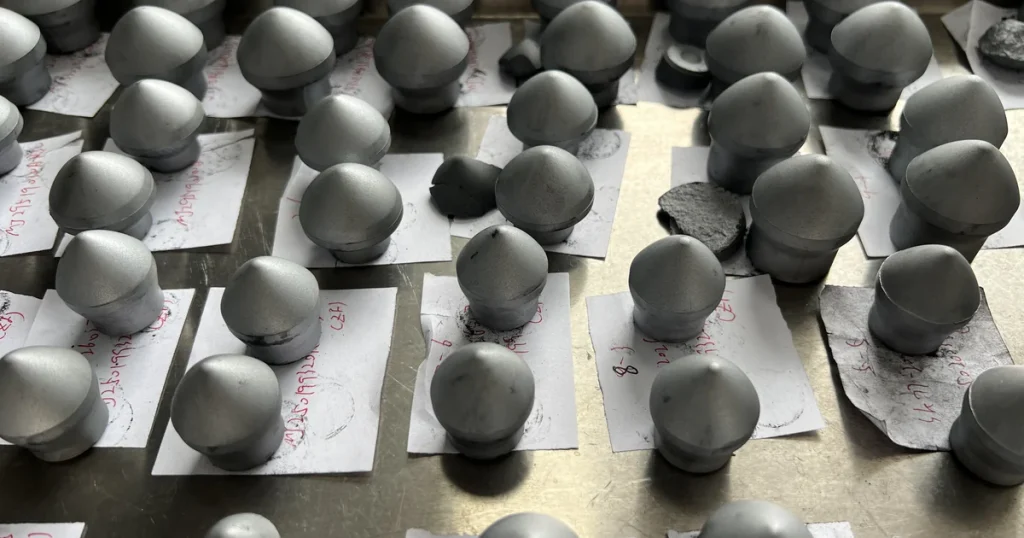
SR8C or SR10C. The spec sheets differ by a single HRA point and one cobalt percentage. On a longwall face with unpredictable sandstone bands, the wrong choice doesn’t fail slowly – it snaps in the first shift. The decisive variable is the one failure mode that dominates your face: fracture or wear.
Evidence scope: This article uses documented Ruixin product specifications and material-property references. It does not contain case-study or customer‑specific field‑performance data. All application guidance is a selection framework that must be validated through a controlled face trial under the reader’s own mining conditions.
Quick Answer
The grade boundary between impact-resistance and wear-resistance for shearer picks is set by the primary failure mode observed on the face. A toughness-positioned grade with higher cobalt content and coarser grain, such as Ruixin SR10C at HRA 88.0 ± 0.5 with flexural strength ≥ 2,200 MPa, is engineered for impact-dominated conditions where tip fracture is the limiting factor. A hardness-positioned grade such as Ruixin SR7X at HRA 91.0 ± 0.5 with a fine 1.0–1.2 µm grain targets abrasive coal seams where uniform wear, not breakage, controls pick life. The majority of mixed-seam longwall faces sit between these two poles, making Ruixin SR8C at HRA 89.0 ± 0.5 with flexural strength ≥ 2,200 MPa the correct starting point for balanced performance – but only a failure-mode audit across the full face run can confirm whether that balance is real.
If your current picks are failing by fracture, moving up in cobalt is the answer. If they are wearing to a flat prematurely, moving down in cobalt and up in hardness is the route. The rest of this article defines how to tell the difference without a laboratory, and how to structure a controlled trial that gives you an engineering answer, not a sales claim.
Why Carbide Tips Fail Differently in the Same Seam
Two shearer drums cutting the same longwall block can show completely different failure patterns within days. The reason is not the carbide quality – it is the local variation in seam geology that most production reports do not capture. A 200‑meter face rarely cuts uniform coal for the full run. Sandstone bands, pyrite nodules, and abrupt changes in cleat spacing create alternating zones of pure abrasion and high shock loading. These geological discontinuities mean that a single grade cannot be the optimal solution everywhere on the face; the question is which failure mode is costing the most picks per shift and adjusting the grade toward that weak point.
The failure mode that appears first and most often is the one your grade selection must solve. The operational challenge is that a grade optimized for one zone will underperform in the other. A wear‑resistant grade like Ruixin SR7X, with a dense ultra‑fine grain structure (1.0–1.2 µm) and HRA 91.0, resists abrasive grain plucking exceptionally well in fine‑coal conditions but has lower crack‑arrest capacity when a tip strikes a hard intrusive band at shearer‑drum velocity. The result is a brittle fracture mode that produces catastrophic tip loss – a failure pattern that looks like a quality defect but is in fact a predictable outcome of grade mismatch under impact loading.
Ruixin SR8C, with 2.0–3.0 µm grain size and HRA 89.0 ± 0.5, is the balanced starting point for faces where both wear and impact appear, because the medium grain provides enough toughness to survive moderate shock while retaining sufficient hardness for reasonable wear life. The threshold to move toward SR10C (higher toughness, HRA 88.0 ± 0.5) is reached when tip fracture or body breakage accounts for a clearly disproportionate share of pick changes across a full face cycle. The threshold to move toward SR7X (higher wear resistance, HRA 91.0 ± 0.5) is reached when picks are pulling for uniform wear‑flat progression with no fracture signatures. The selection narrows to one of these three grades once the failure‑mode audit is complete.
Understanding Grain Size and Cobalt’s Dual Role

In cemented carbide, hardness and fracture toughness move in opposite directions, and the two levers that control that relationship are cobalt binder content and tungsten carbide grain size. More cobalt increases the ductile binder phase between carbide grains, raising flexural strength but lowering hardness. Finer grain packs more grain boundaries into the same volume, boosting hardness at the expense of crack‑deflection capacity. The grade‑selection conversation often focuses on cobalt percentage, but grain size is an equally important variable because two grades with the same cobalt level can behave differently if their grain structures are not identical.
Ruixin SR7X uses a 1.0–1.2 µm grain to achieve HRA 91.0 ± 0.5, while SR8C and SR10C use 2.0–3.0 µm grains. That grain‑size shift explains why SR8C, even with lower hardness than SR7X, delivers ≥ 2,200 MPa flexural strength, a full 200 MPa above the SR7X minimum. The coarser structure arrests cracks more effectively because the longer cobalt‑phase path between grains absorbs more impact energy before catastrophic failure. In a shearer drum application, this means SR8C can survive a passing encounter with a sandstone band that would chip or fracture an ultra‑fine‑grain tip in the same location.
Cobalt content adds another dimension. SR8C and SR10C share the same grain architecture, but SR10C’s higher cobalt fraction pushes the toughness envelope further while sacrificing an additional HRA point. That small hardness drop matters only when wear‑flat progression, not fracture, limits pick life. The interplay of these two variables – grain size and cobalt – is the engineering reason why Ruixin’s three shearer‑pick grades do not form a simple “good‑better‑best” hierarchy. Each is the correct choice for a distinct set of face conditions, and the failure mode determines which lever to pull.
Hardness, Toughness, and Application Fit: The Three-Grade Spectrum
Ruixin manufactures three carbide grades that span the impact‑abrasion spectrum for shearer picks. The table below maps each grade to its failure‑mode fit. All values are material specifications, not guaranteed field‑life results. These grades share cobalt‑carbide metallurgy but differ in the hardness‑toughness balance set by grain size and cobalt content, making each the correct choice for a distinct set of face conditions.
| Grade | Hardness (HRA) | Flexural Strength (MPa) | Grain Size (µm) | Primary Positioning | Best Fit When |
|---|---|---|---|---|---|
| SR7X | 91.0 ± 0.5 | ≥ 2,000 | 1.0–1.2 | High wear resistance | Uniform abrasive wear is the dominant failure; fracture is absent or rare |
| SR8C | 89.0 ± 0.5 | ≥ 2,200 | 2.0–3.0 | Balanced wear/toughness | Both wear and occasional impact appear; no single mode dominates |
| SR10C | 88.0 ± 0.5 | ≥ 2,200 | 2.0–3.0 | Higher toughness; impact survival | Tip fracture or body breakage is the primary pick‑change reason |
SR7X uses the finest grain to create a dense, high‑hardness structure that resists abrasive grain plucking in fine‑coal and low‑impact conditions. SR8C and SR10C use coarser grain, which provides more crack‑arrest capacity when the tip encounters a hard inclusion at shearer‑drum velocity. The flexural strength floor of ≥ 2,200 MPa on SR8C and SR10C reflects this toughness positioning – a direct engineering trade‑off against the higher hardness of SR7X. Because SR10C matches the flexural strength of SR8C while shifting the hardness lower, the move from SR8C to SR10C is justified only when the impact frequency and energy are high enough that the HRA difference is irrelevant compared to fracture prevention. If you are not seeing fracture or body breakage on the majority of pulled picks, SR10C is the wrong direction – you are trading wear life for toughness you do not need.
The table is a selection compass, not a prescription. Face‑specific variables including drum speed, water flushing, and intrusion frequency can push the effective failure mode toward one end of the spectrum even when the seam description suggests the other. A controlled trial that isolates the carbide grade is the only way to validate which of these three compass points matches the real failure‑mode distribution on the face.
How Water, Cleat, and Cutter Design Change the Grade Equation
Carbide grade selection never happens in isolation from the cutting system. Three variables routinely shift the impact‑abrasion balance enough to make a correctly specified grade perform like the wrong one. These factors must be accounted for before committing to a full face order, because the grade that works at standard drum RPM in dry cutting may fail prematurely when water pressure or pick spacing changes.
Cutting speed and pick spacing. Higher drum RPM increases the impact energy per pick strike, especially at the face corners where lacing patterns change. If the current drum configuration produces higher‑than‑standard impact loads, a grade positioned for balanced wear may fracture prematurely. Ruixin SR10C, with its higher‑toughness positioning, becomes the candidate when increased drum speed or tighter pick spacing amplifies impact energy beyond the limits of a balanced grade like SR8C. The same principle applies in reverse: if drum speed is reduced to control dust, the impact energy per strike drops, and a wear‑oriented grade like SR7X becomes viable even in a seam with occasional intrusions.
Water and flushing. High‑pressure water jets directed at the pick tip for dust suppression can accelerate cobalt leaching in the surface layer of the carbide. This effect is more pronounced in finer‑grain, higher‑hardness grades where the cobalt mean free path is shorter. In wet‑cutting faces with aggressive water pressure, Ruixin SR8C with its 2.0–3.0 µm grain structure may retain surface integrity longer than an ultra‑fine grade – an advantage that disappears in dry cutting where abrasion alone drives the wear mechanism. When water pressure is a constant variable, the grade selection must include a wet‑cutting trial; a dry lab test or a specification sheet comparison does not capture the cobalt‑depletion effect.
Seam intrusions. The hardest part of the coal seam is not the coal. It is the sandstone bands, pyrite concretions, and mudstone partings that occupy anywhere from a minor fraction to a dominant share of the cut. When these intrusions are thick and frequent, the impact loading on the tip can exceed the fracture toughness of a wear‑grade carbide. Longwall mining carbide grade selection must start with a geological map of the face, not a coal hardness number alone. A seam with meter‑scale sandstone bands changes the grade requirement from “wear‑resistant” to “impact‑tolerant” regardless of the coal’s inherent abrasivity. The interaction between intrusion frequency and carbide grade is the single largest source of preventable pick consumption in mixed‑seam faces.
Reading the Wear‑Flat Signal on Pulled Picks
A pulled shearer pick carries more information than a simple pass/fail. The geometry and texture of the wear flat tell you whether the dominant removal mechanism is two‑body abrasion, three‑body gouging, micro‑chipping, or macroscopic fracture. A smoothly worn flat with a uniform width across the tip circumference points to steady‑state abrasive wear. That signal suggests the current grade’s hardness is the limiting factor, and a shift toward a higher‑hardness, finer‑grain grade such as Ruixin SR7X can reduce the rate of wear‑flat progression without introducing a fracture risk.
Irregular wear flats with jagged edges, micro‑spalling, or distinct facet angles indicate that the tip is experiencing intermittent brittle events superimposed on abrasive removal. This mixed signal is common in faces where sandstone partings appear unpredictably. In those conditions, a balanced grade like Ruixin SR8C is usually the better match because its coarser grain arrests the short cracks that initiate micro‑chipping while still offering acceptable wear resistance. The observation that matters is the proportion of picks showing micro‑chipping versus those with clean, uniform flats. If micro‑chipping appears on a significant fraction of recovered picks, moving toward a tougher grade is warranted even if some picks still show only wear.
The most dangerous signal is a completely missing tip with a clean steel body – a fracture that leaves no carbide residue. This is almost always a grade‑toughness failure, not a manufacturing defect, and it usually coincides with the section of the face where sandstone bands are thickest. When fracture rate climbs sharply in a known intrusion zone, a toughness‑oriented grade like Ruixin SR10C is the immediate candidate. The investment in a split‑drum trial that targets that zone directly delivers a faster answer than running a full‑face comparison for weeks and averaging the data across geology.
Designing a Controlled Face Trial That Isolates Carbide Grade

A controlled trial answers the grade question without committing the entire face set. The test framework below uses the existing drum and operating parameters to isolate the carbide grade as the only variable. The goal is not to find a universal winner but to identify which of the three Ruixin grades – SR7X, SR8C, or SR10C – minimizes the dominant failure mode under your exact conditions.
Step 1: Map the failure mode of the current grade across the full face width. For one complete shearer pass, collect every pulled pick and sort by failure type: tip fracture (body intact, tip missing), body breakage (steel body intact, carbide fractured or dislodged), uniform wear‑flat (no fracture, symmetrical wear), and asymmetric wear. Count and photograph each category. If tip fracture plus body breakage accounts for the majority of pick changes, impact‑toughness is likely the limiting factor – ask your supplier for a high‑toughness grade like Ruixin SR10C. If uniform wear‑flat dominates and fracture is negligible, abrasion is the primary driver – ask for an abrasion‑resistant grade like Ruixin SR7X. Where both wear and fracture are notable, a balanced grade like Ruixin SR8C may be appropriate; confirm with your supplier.
Step 2: Run a split‑drum trial with the candidate grade. Install the candidate grade on half the drum (alternating blocks, not every other pick – this avoids lacing‑pattern bias). Run for at least one full shearer cycle across the entire face width to expose both grades to the same geological variation. Record pick changes, wear‑flat width, and any fracture events for each grade independently. This split‑drum method directly compares the incumbent and candidate grades under identical face conditions, eliminating the geological variability that confuses sequential trials.
Step 3: Compare failure‑mode distribution, not just pick count. A lower total pick‑change count is only meaningful if the failure modes are the same. A new grade that shifts failure from fracture to uniform wear but increases total pick consumption by a modest margin may still be the correct choice – fractures create downtime from missed pick detection and drum damage risk that uniform wear does not. The decision criterion is not “fewer picks changed” but “fewer unscheduled stops and lower drum‑body repair costs.” After the trial, present the failure‑mode breakdown to your supplier so the engineering team can recommend the final grade and confirm dimensional compatibility for your shearer model with carbide tips for shearer picks.
Geotechnical Data as a Grade‑Selection Input
Carbide grade selection that ignores the geotechnical log of the longwall block is grade selection with one eye closed. The block report, if it exists, typically includes uniaxial compressive strength, Cerchar abrasivity index, and a lithological column that shows the thickness and frequency of sandstone bands, mudstone partings, and coal plies. These data points do not need to be fed into a formula; they are a checklist that flags whether the face is likely to be wear‑limited, impact‑limited, or a mixture.
A block with a high Cerchar abrasivity index and few thick intrusions points directly to a wear‑limited face. In that geology, the carbide’s hardness and grain‑size resistance to abrasive plucking become the priority, and Ruixin SR7X’s fine‑grain, high‑hardness architecture aligns with that requirement. Conversely, a block with a moderate abrasivity index but frequent, thin sandstone bands presents an impact‑dominated failure profile. Even if the coal itself is only moderately abrasive, the repeated shock loads from the bands will fracture a wear‑grade tip long before wear‑flat progression becomes a concern. In that case, Ruixin SR10C’s higher toughness is the correct starting candidate.
When the geological column shows a complex mixture across a broad interval of the seam – the zone where neither extreme holds – the balance of evidence then supports selecting a trial grade through a structured evaluation. Ask the supplier to recommend a grade suitable for mixed lithology conditions and confirm suitability with controlled face trials. Drum speed, water flushing, and lacing geometry can tip the balance toward fracture or wear in specific face sections. The geotechnical log does not make the final decision; it provides the boundary conditions that justify the trial grade and prevents an engineering team from starting the selection process in the wrong part of the grade spectrum.
From Trial to Production: Locking In Batch Consistency
A successful split‑drum trial proves that a particular combination of grade, geometry, and drum parameters works under the trial conditions. It does not, by itself, guarantee that every future shipment of the same grade designation will replicate that result. Batch‑to‑batch variation in carbide production is a known risk, driven by raw‑material powder consistency, sintering‑cycle repeatability, and post‑sinter processing. The only reliable defense is documentation: a material test report for every batch that reports density, HRA hardness, and flexural strength against the Ruixin grade specification.
When the trial batch succeeds, ask your supplier to hold the batch record and issue a material test report with measured values for those three parameters. That report becomes the reference for the production order. Confirm with your supplier that subsequent batches will also be accompanied by a material test report so you can compare each incoming lot against the trial benchmark. This practice transforms grade selection from a one‑time experiment into a controlled procurement process. Without batch‑level documentation, a decline in field performance cannot be distinguished from a grade change, a drift in sintering, or an unrelated drum‑maintenance issue.
Beyond material certification, dimensional inspection data for the carbide tips should be part of the production‑order package. Shearer pick pockets have tight tolerances, and a shift in carbide‑tip diameter or shank length can affect brazing quality and load transfer, creating a failure signal that looks like a grade problem but is mechanical in origin. By insisting on dimensional records alongside material test reports, the engineering team closes the loop between the trial result and sustained full‑face performance. The same principle applies when scaling the grade to other mining tools: a grade that works for shearer picks on one face can be evaluated for rotary drilling carbide inserts, shield machine carbide tips, road milling carbide inserts, and DTH drill bit carbide buttons using the same failure‑mode audit and material‑documentation approach.
The application-level selection is covered in the Shearer Pick Carbide Grade, including the inputs that change the recommendation.
Frequently Asked Questions
What is the best carbide grade for longwall shearer picks in high-impact coal seams?
A higher‑toughness grade with coarser grain and higher cobalt content is the correct starting point. Ruixin SR10C at HRA 88.0 ± 0.5 with flexural strength ≥ 2,200 MPa and 2.0–3.0 µm grain size is positioned for impact‑dominated service where tip fracture is the primary failure mode. The grade does not guarantee a specific pick life – actual results depend on seam geology, drum design, cutting parameters, and water conditions – but the material properties are engineered for impact survival over wear resistance. A split‑drum trial against the incumbent grade is the only way to confirm the performance difference on a specific face.
Why do carbide tips fracture prematurely in hard coal seam cutting?
Premature fracture is typically driven by a grade mismatch: a wear‑optimized grade with high hardness (HRA 91+) and fine grain (below 1.2 µm) is being used in high‑impact conditions that exceed its flexural strength limit. The fine‑grain structure that resists abrasive grain plucking also provides less crack‑arrest capacity when the tip strikes a sandstone band or pyrite nodule at shearer‑drum velocity. The solution is switching to a toughness‑positioned grade with higher cobalt binder content and coarser grain structure, such as Ruixin SR10C. Before switching, confirm the failure mode distribution across the full face – random fracture on a few picks maypoint to a lacing or drum‑speed issue, not a grade problem. A detailed failure‑mode audit that separates fracture events by face location and correlates them with the geological log will reveal whether the root cause is metallurgical, mechanical, or geological.
SR8C vs SR10C: which carbide grade is better for shearer picks in mixed strata?
Ruixin SR8C is the balanced starting point for variable conditions: HRA 89.0 ± 0.5, flexural strength ≥ 2,200 MPa, and 2.0–3.0 µm grain size. SR10C at HRA 88.0 ± 0.5 with the same flexural strength minimum shifts the balance toward toughness. If the dominant failure mode across the face is tip fracture rather than uniform wear, SR10C is the stronger candidate. If fracture is present but not dominant, SR8C will typically deliver longer total wear life because the higher hardness slows wear‑flat progression without sacrificing the flexural strength floor. A controlled face trial comparing both grades in the same shearer drum run is the decisive test for your specific conditions.
How does drum speed affect carbide grade selection for shearer picks?
Higher drum RPM increases the kinetic energy of each pick strike, effectively shifting the impact‑abrasion balance toward impact. A grade that performs well at standard RPM may fracture at elevated speed because the impact energy per strike exceeds the material’s crack‑initiation threshold. If your operation runs higher‑than‑standard drum speeds, the grade selection should bias toward toughness – consider moving from Ruixin SR8C toward SR10C – and validate the choice with failure‑mode data collected at the operating RPM, not at a reduced test speed. The relationship between RPM and impact energy is non‑linear, so a small speed increase can have a disproportionate effect on fracture rate in grades positioned near the edge of their toughness envelope.
What documents should accompany a carbide grade trial order?
Request a material test report for the trial batch that includes measured density (g/cm³), hardness (HRA), and flexural strength (MPa). These three values confirm that the trial material matches the Ruixin grade specification and establish a baseline for comparing future production batches. Without batch‑level documentation, a successful trial cannot be reliably reproduced in subsequent orders. Additionally, request dimensional inspection data for the carbide tips to confirm OEM compatibility with your shearer drum pockets. This documentation ensures that the grade performance seen in the trial is repeatable at production scale and protects against the most common source of post‑trial performance drift: batch variation that goes undetected because no one asked for the numbers.
How do I match carbide grade to sandstone band frequency in a coal seam?
Sandstone band frequency is a better predictor of required impact toughness than coal hardness alone. When bands appear frequently but are thin, a balanced grade like Ruixin SR8C often suffices because the energy per strike, while repeated, stays below the crack‑propagation threshold for a medium‑grain structure. When bands are thick and occupy a significant fraction of the cut, the cumulative shock loading pushes the requirement toward Ruixin SR10C, which has the toughness reserve to absorb repeated high‑energy strikes without accumulating micro‑cracks that eventually cause body breakage. The geotechnical log of the block is the starting document; correlate band thickness and frequency with pick‑change locations on the face to build the failure‑mode map that justifies the grade decision.
Get a Custom Shearer Pick Carbide Grade Recommendation
Get a Custom Grade Recommendation
Send your current pick failure data, seam description, and shearer model to Ruixin Tungsten Carbide. We reply within one business day with a candidate grade, dimensional drawings, and trial‑quantity pricing. Contact our engineering team directly:
- Email: info@ruixintungstencarbide.com
- Phone: +86-15253178777
- WhatsApp: +86-15253178777
For adjacent tooling on the same mine site – rotary drilling bits, TBM cutter heads, road milling drums, or DTH hammers – the same grade‑matching logic applies across the full Ruixin product range. Our engineering team can evaluate the failure‑mode data from any cemented carbide application and recommend the correct grade from the SR7X‑SR8C‑SR10C spectrum. Whether you are changing grades on a single shearer drum or standardizing carbide specification across a fleet, the process starts with the failure‑mode data from your face. Send that data, and we will return an engineer‑to‑engineer recommendation that treats grade selection as the system it is, not the catalog guess it should never be.
 English
  Russian
  Spanish
  French